


The Kiosk Index — What StreetMetrics Actually Found (and What Everyone Missed)
Start with a number that doesn’t look like a headline: 131. That’s the index at which men aged 25 to 34 over-index on kiosk exposure, meaning they are 31 percent more likely than the average adult to be reached by kiosks — the highest index among all OOH formats for this cohort. Digital street furniture trails just behind at 122 for the same group, a pattern that makes structural sense given that most kiosks are now digital anyway. The data comes from StreetMetrics audience indexing, and the trade press framed it as a Father’s Day planning insight: if you want younger dads, layer kiosks on top of your core buy.
That framing is fine as far as it goes. It doesn’t go far enough.
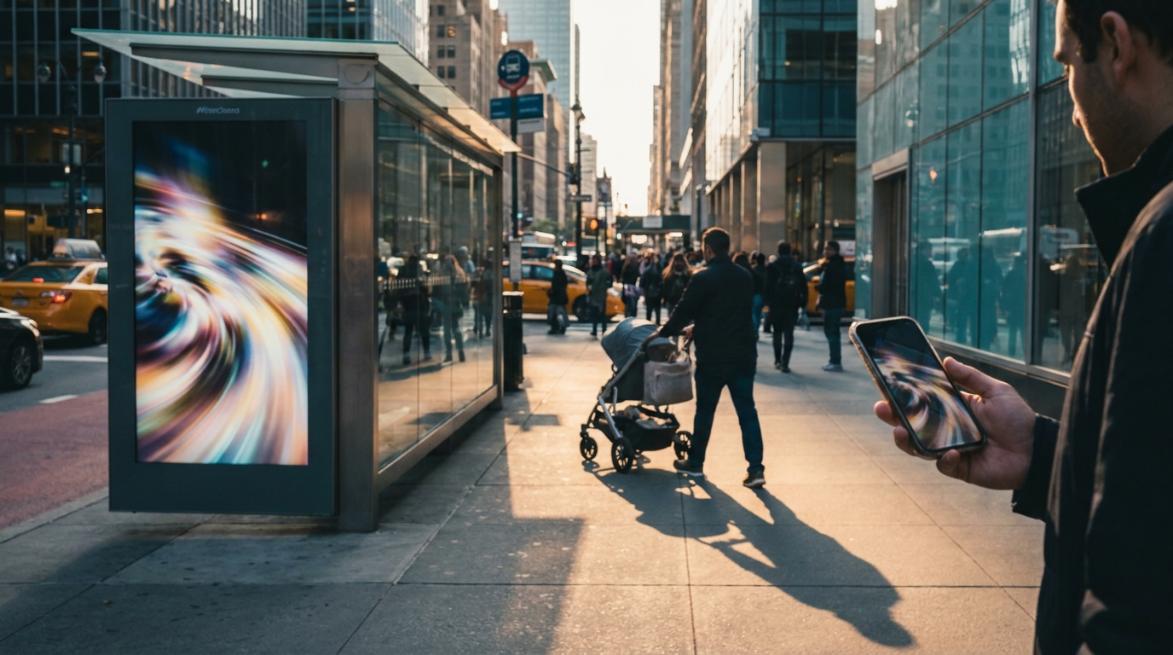
The 131 index is not a preference metric. Nobody in the sample was asked whether they like kiosks, whether they find kiosk ads trustworthy, or whether they’d recommend the kiosk experience to a friend. The number measures exposure — specifically, disproportionate exposure relative to the general population. In other words, these men aren’t choosing kiosks. Kiosks are choosing them. The format sits at eye level on the sidewalk, precisely where a 28-year-old pushing a stroller or walking to a train has no real option to look away. The encounter happens in motion, at street grade, in the peripheral field of vision. It is, in the most literal sense, involuntary capture.
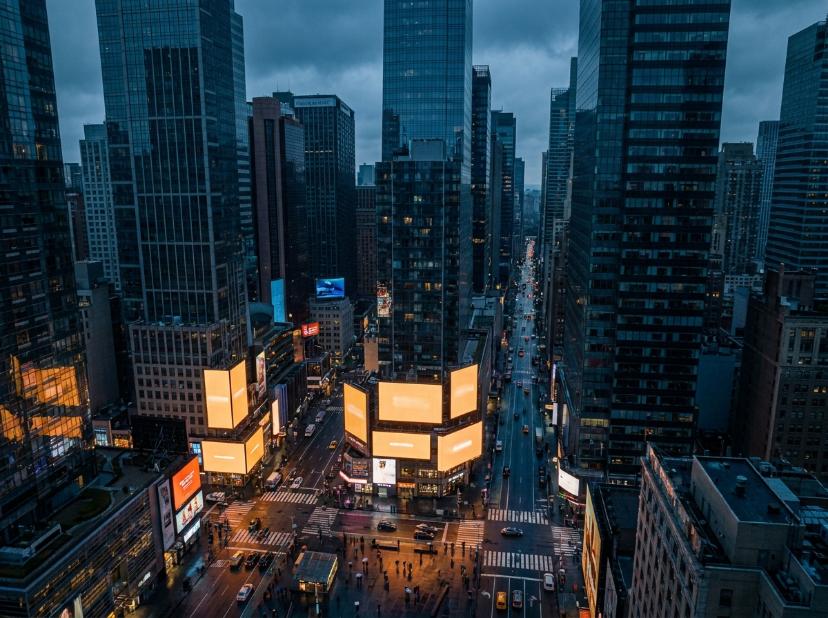
This distinction matters because it maps cleanly onto a framework that AdQuick’s research team has been building around the difference between active and passive advertising. Active formats — pre-roll, interstitials, pop-ups — demand a decision. You can accept the ad or refuse it, and as AdQuick’s analysis of the Kochava cross-media study explains, refusing it requires effort, and after enough refusals the consumer’s effort calcifies into resentment. OOH does not trigger that cycle. You don’t choose to see the billboard or the kiosk. You also don’t develop conscious hostility toward it, because it lives in the periphery of your attention rather than at the center. AdQuick compared it to the difference between someone whispering a fact in your ear every morning during coffee and someone emailing you the same fact ten times — both deliver the message, but only one generates an HR complaint.
The Kochava data underneath that framework is striking: from one exposure to ten, OOH digital conversion rates climb from 0.24 percent to 1.28 percent — a sixfold increase and the cleanest upward frequency curve of any media type in the study. Broadcast TV, by contrast, flatlines at 0.22 percent. The implication is that repeated passive exposure doesn’t just avoid resentment; it compounds effectiveness. The planning orthodoxy of digital media — cap frequency, rotate creative, avoid fatigue — runs exactly backward when applied to formats that operate on peripheral attention rather than demanded attention.
Now bring those two findings together. The StreetMetrics kiosk index tells you who is being captured: young men in motion at street level. The AdQuick passive-attention framework tells you how the capture works: without consent, without skip buttons, and without the resentment tax that erodes every impression in an active-attention channel. The 131 isn’t about kiosks being cool. It’s about kiosks being unavoidable, in a way that also happens to be tolerable. That combination — high involuntary reach plus low psychological friction — is the format physics worth isolating, because it doesn’t belong exclusively to out-of-home. It shows up any time a piece of content meets a person in motion, at eye level, inside a feed they’re already scrolling. Which is exactly what happens on another platform entirely.
The Passive Attention Paradox — Why Formats That Don’t Ask Permission Outperform Formats That Do
The advertising industry has spent two decades solving for a problem it created. Frequency capping, creative rotation, A/B testing of ad fatigue thresholds — these are all sophisticated countermeasures designed to manage a single underlying condition: people resent being interrupted, and the more you interrupt them, the more they resent you. The entire digital media optimization stack is, at its core, a burnout mitigation engine.
But what if the format itself never triggers burnout in the first place?
That’s the question sitting inside the Kochava cross-media data that AdQuick published in its analysis of the most expensive case of misattribution in modern advertising. The numbers are striking in their clarity: from one exposure to ten exposures, OOH digital conversion rates climbed from 0.24 percent to 1.28 percent — a sixfold increase and the cleanest upward frequency curve of any media type in the study. Broadcast TV, meanwhile, plateaued at 0.22 percent and barely moved. Connected TV climbed gently. OOH just kept going up.
The mechanism behind this divergence isn’t complicated, but it is counterintuitive for anyone raised on digital planning logic. Active media — pre-roll, mid-roll, display interstitials — demands a decision from the viewer. You must either accept it or refuse it, and refusing it requires effort. As the AdQuick study frames it, after enough refusals that effort calcifies into resentment. This is the resentment cycle, and it’s why frequency hurts most digital formats. Every additional impression pushes the consumer closer to active hostility toward the brand.
OOH sidesteps this entirely because it is passive. You don’t choose to see a billboard or a kiosk. You don’t have the option to skip it. But crucially, you also don’t develop conscious resentment toward it, because it lives in the periphery of your attention rather than at its center. Each additional exposure deepens familiarity without deepening annoyance. The whisper gets remembered. The tenth email gets reported as spam.
This is exactly the dynamic that explains the kiosk data from Section 1. Those younger dads with a 131 index on kiosk exposure aren’t stopping to read an ad. They’re absorbing it while navigating a sidewalk, holding a coffee, checking a stroller. The format works because it doesn’t demand their focus — it simply occupies the same space they already inhabit.
Now carry that psychology to TikTok. The platform’s strongest-performing ads succeed precisely because they mimic the passive-attention dynamic of out-of-home, even though they technically live inside a digital feed. As Neil Patel’s analysis of TikTok’s premium ad formats explains, the key difference is that TikTok ads at their best look and feel like the content people are already watching, which drives higher engagement than formats that announce themselves as interruptions. A creator casually mentioning a product while telling a story doesn’t trigger the resentment cycle. It registers the way a kiosk registers — peripheral, ambient, absorbed without friction.
This is the passive attention paradox: the formats that don’t ask for your attention end up earning more of it. And the formats that demand it — pre-roll, pop-ups, autoplay with sound — end up training consumers to build psychological firewalls against the very brands paying for the impressions. The industry spent twenty years optimizing digital against burnout because digital is fundamentally interruptive. OOH keeps climbing because it was never interruptive to begin with. TikTok’s best creative borrows that same instinct and smuggles it into a phone screen.
TikTok’s Quiet Trick — Engineering “Passive” Attention Inside an Active Medium
Every other social platform hands you something and then asks you to decide what to do with it. A Facebook post sits in a feed alongside six other posts, a sidebar ad, a notification badge, and a Marketplace prompt. An Instagram Reel competes with Stories trays, DMs, and the Explore grid. The user is constantly triangulating — scanning, evaluating, choosing. That’s active attention in an active medium, and it’s exactly the environment where the skip instinct thrives.
TikTok did something structurally different. It removed the triangulation.
One video. Full screen. Sound on. No competing elements. No sidebar. No visible menu until you swipe. The For You Page is not a feed in the way that term has been used since Facebook’s News Feed launched in 2006. It is a sequence — algorithmically ordered, individually served, and designed so that each piece of content occupies the entirety of your visual and auditory field before you make any decision about it. You encounter the content the way a pedestrian encounters a kiosk: it is already there, at eye level, filling your frame, before the conscious choice to engage or dismiss even begins to form.
This is the architecture that produces TikTok’s now-famous 3.7 percent engagement rate, a figure nearly eight times higher than Instagram’s and twenty-five times higher than Facebook’s. The instinct is to attribute that gap to better targeting or younger demographics. But the real mechanism is environmental. TikTok engineered passive-feeling attention inside an active medium. The scroll is the sidewalk. The For You Page is the streetscape. And the moment of involuntary capture — the half-second where you’ve already absorbed the image, the motion, the opening hook before your thumb moves — is the same moment that makes street-level kiosks so effective for younger dads who over-index on that format precisely because it sits in their line of sight during routines they aren’t consciously monitoring for advertising.
TikTok’s newest premium formats push this dynamic even further. Logo Takeover places a brand at the moment users open the app, before anything else on the screen competes for attention — functionally identical to a digital billboard dominating an intersection you can’t avoid. Prime Time delivers up to three sequential ads from the same brand within a fifteen-minute window, replicating the repeated-exposure pattern that OOH frequency data shows climbing conversion rates from one impression to ten without burnout. These are not interruptive placements. They are environmental ones.
But the format only works if the creative honors the contract. The reason TikTok’s ad engagement dwarfs every other platform is not just the full-screen architecture — it is that the best-performing ads don’t look like advertising. As TikTok’s own creative guidance emphasizes, and as tools like Symphony AI are designed to facilitate, the content that wins is content that looks like something a person would make and share. Symphony, built on ByteDance’s Seedance video model, lets brands generate TikTok-first creative from text prompts or existing assets — lowering the production bar while keeping output native to the platform’s visual grammar. The tool exists because TikTok understands that the moment an ad looks like an ad, the passive attention contract shatters. The user’s thumb moves. The kiosk becomes a pop-up flyer someone is shoving into your hands on the sidewalk.
This is TikTok’s quiet trick, and it is the reason media mix models that still slot it into a “social” budget silo are fundamentally miscategorizing what it does. TikTok is not competing with Instagram for social dollars. It is competing with OOH and streaming for ambient-attention dollars — and it is winning because it solved a problem those channels never had to face: how to make chosen media feel unchosen.
The Same Dad, Two Formats, One Psychology — Mapping the OOH-to-TikTok Creative Translation
Start with a number that should make every performance marketer pause. Men aged 25 to 34 are 31 percent more likely than the average adult to be reached by kiosks, indexing at 131 — the highest of any OOH format for this demographic. Now hold that fact next to this one: the same 25-to-34 age group is TikTok’s single largest cohort, representing 40 percent of the platform’s user base. Two entirely different media channels. Two entirely different measurement ecosystems. The same men, over-indexing in both places at the same time. That is not a demographic coincidence. It is the same attention profile expressing itself across two surfaces.
The reason becomes clear when you map the structural attributes of each format side by side. Kiosks are street-level and eye-level — they exist in the pedestrian’s natural line of sight, not above it on a billboard or beside it in a newspaper box. TikTok’s full-screen vertical format does the same thing digitally: the ad occupies the exact visual frame the user is already focused on. No sidebar. No competing grid. Eye-level framing, in both cases, means the creative doesn’t need to earn a glance. It starts with one.
Both formats are encountered in motion. A kiosk catches someone mid-stride; a TikTok ad catches someone mid-scroll. In neither case does the viewer make an affirmative decision to engage with advertising. The content simply appears inside an activity the person was already doing. This is the “no opt-in required” principle: the ad doesn’t ask permission, but it also doesn’t obstruct the activity. It rides alongside it. That distinction matters because it determines whether repeated exposure produces familiarity or resentment — and the data on this point is unambiguous. As the Kochava cross-media study analyzed by AdQuick demonstrated, OOH digital conversion rates climb steadily from 0.24 percent at one exposure to 1.28 percent at ten — a sixfold increase with no sign of fatigue. Compare that to broadcast TV, which plateaus almost immediately.
TikTok’s engagement dynamics mirror this frequency-reward curve rather than the frequency-punishment curve of interruptive digital formats. Users return to TikTok an average of five to fifteen times per day, creating natural repeat-exposure windows that function like walking past the same kiosk on your morning and evening commute. The creative that works in both environments shares a final attribute: contextual nativeness. A kiosk ad that looks like a kiosk — clean type, single image, local relevance — outperforms one that looks like a shrunk-down TV spot. A TikTok ad that looks like something a person would actually post outperforms one that looks like a repurposed pre-roll.
Here is the practical upshot: if you are a performance marketer building TikTok creative for men 25 to 34, you already have a proven creative brief. You just need to borrow it from OOH format psychology. Frame at eye level — which on TikTok means shooting vertical, centered, with the subject filling the screen. Design for motion encounter — which means your first frame must work on someone who didn’t choose to see it. Stay contextually native — which means the ad should be indistinguishable from organic content until the value proposition lands. And plan for frequency reward rather than frequency punishment — which means building creative that reveals layers on repeat views instead of exhausting its message on the first one. The kiosk already taught you everything you need to know. The phone screen is just a kiosk that fits in a pocket.
The Two-World Problem — Why This Connection Gets Missed and What It Costs You
The reason this connection between OOH instinct and TikTok response keeps getting missed isn’t psychological — it’s organizational. Somewhere between the quarterly planning cycle and the vendor pitch, the insight that involuntary attention works the same way across physical and digital environments gets sliced into two budgets, assigned to two teams, measured by two completely different stacks, and presented at two industry conferences that share almost no attendees. The result is a structural blind spot that costs real money.
Start with the budget architecture. As Neil Patel observes, TikTok is still sitting in a social budget silo at most organizations, weighted against Instagram and Snapchat rather than evaluated for what it can deliver against video and streaming objectives. Meanwhile, OOH lives in a “brand” or “awareness” budget governed by entirely different KPIs. The paid social team optimizes for cost-per-click and thumb-stop rate. The OOH team optimizes for reach and frequency against a DMA. Neither team has any institutional reason to compare notes on why certain creative structures — bold typography at the top, a single focal product, motion that resolves in under two seconds — command attention in both environments. So they don’t.
The measurement problem makes the silo worse. A landmark cross-media study by Kochava found that OOH delivers twice the median action lift of broadcast TV — twenty percent for in-person actions, fourteen percent for digital — yet most digital attribution windows cap at seven days, which AdQuick’s analysis calls the most expensive case of misattribution in modern advertising. When the attribution window was extended to twenty-eight days, a massive trail of OOH-driven conversions appeared in the data that no one had bothered to look for. The implication is damning: channels that the industry has spent a generation calling “performance” have been quietly absorbing credit from the medium that actually primed the consumer’s intent.
But there’s a subtler, equally expensive misattribution happening at the creative strategy level. When your paid social team A/B tests three hundred TikTok ad variants in a quarter — burning through creative production budget and platform spend to find the five or six executions that outperform — they are rediscovering through expensive trial and error what decades of OOH format research already knows. The kiosk data showing that men 25 to 34 over-index at 131 on street-level formats isn’t just a media placement insight. It’s a creative insight: eye-level, portrait-oriented, high-contrast visuals with minimal copy and immediate product recognition are the formats this demographic literally cannot walk past. Those same principles predict which TikTok hooks will stop a thumb before the conscious brain has time to swipe.
Every testing cycle that ignores this existing knowledge is a cycle where you’re paying to relearn physics. The creative team burns budget iterating toward a structure that OOH planners could have briefed them on in a single slide. The media mix model, meanwhile, underweights both channels — TikTok because it’s trapped in the social silo, OOH because its conversions fall outside the attribution window — ensuring that the two formats with the strongest claim on involuntary attention receive the least strategic coordination. The silo isn’t just an org-chart inconvenience. It’s a P&L leak, and it compounds every quarter it goes unaddressed.