


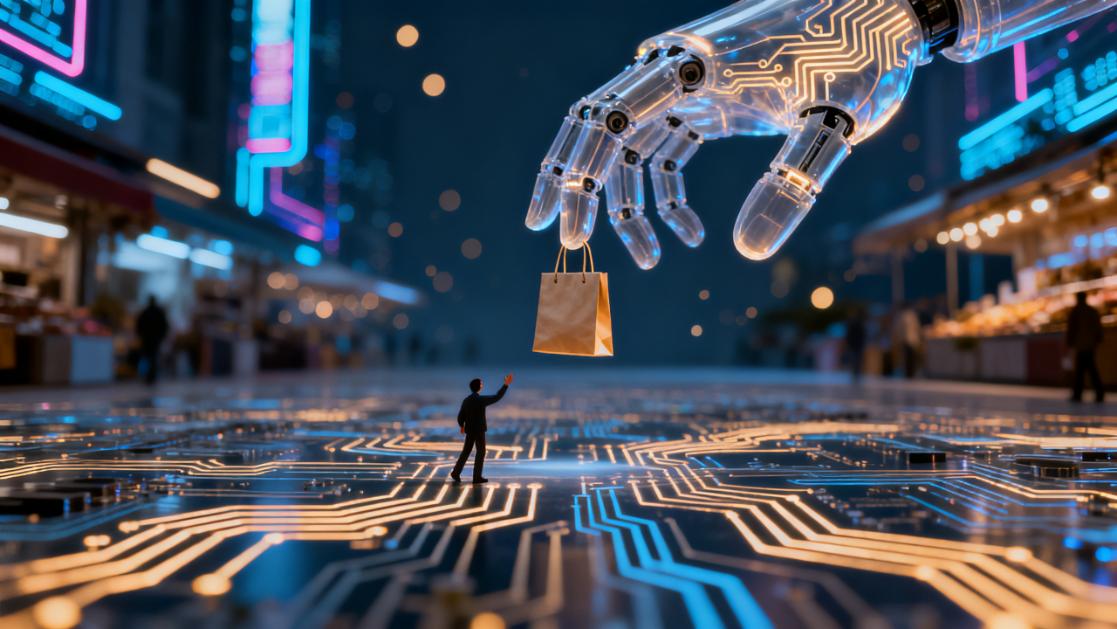
The Architecture of Interception — What Google Actually Announced
Most performance marketers saw the headline — Google is building a shopping cart — and moved on. That was a mistake. What Google announced at I/O 2026 and Marketing Live isn’t a feature. It’s an integrated system engineered to collapse every stage of the purchase funnel into surfaces Google owns, and understanding each component is the only way to grasp how radically this reshapes the traffic economics of native and push campaigns.
Start with the foundation: Universal Cart. As Semrush reported, this is a centralized shopping hub that aggregates products from retailers like Nike, Target, Walmart, Sephora, and Shopify merchants into a single interface spanning Google Search, Gemini, and eventually YouTube and Gmail. Google is careful to note that transactions technically complete on merchants’ sites, but the browsing, comparison, and decision-making all happen within Google’s ecosystem. The user never needs to visit a product page, read a blog review, or click a native ad to reach a purchase decision.

Powering the checkout layer is the Universal Commerce Protocol, an open standard for agentic commerce that enables native checkout directly within AI Mode so users never leave the conversation to complete a purchase. UCP is already live for eligible U.S. retailers and expanding to Canada, Australia, and the U.K. — and as AdExchanger noted, the protocol now extends to ads on YouTube and Google Maps, meaning someone watching a video or browsing a local listing can process a transaction without ever touching an external website. Google is also sweetening the deal for merchants by letting UCP-integrated brands export loyalty points and member-exclusive discounts directly into agentic ad units.
Then there’s Direct Offers, which entered pilot earlier this year and is now expanding significantly. Advertisers upload a pool of discounts, giveaways, and coupons, and Gemini dynamically matches or combines the most relevant incentives into a tailored bundle based on the user’s conversational context. Google’s VP of Ads, Brendon Taylor, drew a sharp line between this format and traditional Shopping ads, explaining that Direct Offers leverage the deep context of an AI Mode conversation to serve a deal precisely when someone is ready to buy. Brands like Chewy, Gap, and L’Oréal are already using the format, with travel platforms like Expedia and Booking.com next.
Layer on top of all this the component most marketers have entirely overlooked: information agents. These are persistent, autonomous agents that continuously scan the web after a user’s initial query and deliver what Google’s Elizabeth Reid called “an intelligent, synthesized update, with the ability to take action.” Rolling out to AI Pro and Ultra subscribers this summer, these agents handle the pre-research phase — the exact stage where a user might otherwise encounter a native content recommendation, a push notification retargeting sequence, or an affiliate review site.
Finally, AI-powered Shopping ads now include explainers that elaborate on why a specific product fits the user’s needs, and Business Agents for Leads let users prompt and interact with a Gemini-trained agent inside the ad itself, replacing the static landing page entirely.
Map these components together and the architecture becomes unmistakable: agents do the research, AI explainers handle the persuasion, Direct Offers assemble the incentive, and UCP-powered checkout closes the sale — all without the user ever leaving Google. Google insists it’s a matchmaker, not a marketplace. But that’s a legal distinction, not a functional one. Functionally, this is Amazon-ification without inventory risk, and it was purpose-built to make the merchant’s website — and especially the affiliate’s — optional.
The Intent Layer You Used to Own Is Now Google’s Product
For years, the most profitable play in performance marketing wasn’t building a brand or even creating a product. It was inserting yourself between a search engine that surfaced intent and a user who hadn’t yet made up their mind. Google would show ten blue links, a user would click through to a content site or advertorial, a retargeting pixel would fire, and then native ad networks and push notification platforms would chase that user across the open web until a conversion happened — sometimes days later, sometimes on the third or fourth touchpoint. The entire downstream economics of native and push campaigns depended on one structural reality: Google identified buyer intent but didn’t fully monetize the decision-making journey that followed the initial click.
That information architecture created an enormous arbitrage layer. Affiliates and media buyers didn’t need to outbid merchants on Google Ads. They needed to outmaneuver them editorially — rank an advertorial for “best mattress for back pain,” capture the click, warm the reader with comparison content, drop a pixel, and then re-engage through push or native placements on Taboola, Outbrain, or MGID at a fraction of the cost per touch. The user arrived from Google uninformed — or at least incompletely informed — and the affiliate’s job was to shape the narrative between that first click and the eventual purchase. Every node in the chain existed because Google left money on the table between the query and the transaction.
Now each of those nodes is being absorbed. As Marketing Dive detailed, Google is rolling out AI-powered Shopping ads that include explainer content about why a specific product is the right choice — the exact editorial function that affiliate landing pages used to serve. Direct Offers use the deep context of an AI Mode conversation to present tailored deals when a user signals purchase readiness, and native checkout means the transaction completes without the user ever leaving Google’s surface. The retargeting pixel never fires because the click to an external site never happens.
But the volume problem isn’t even the most damaging part. The deeper structural threat is what happens to the traffic that does click through. As Moz’s analysis of AI visibility states plainly, “if AI influences decisions before someone visits your site, it removes the incentive to click and shifts where conversions occur.” For performance marketers, that sentence should land like a thunderclap. The users who still click after engaging with an AI overview or agentic shopping flow aren’t the same users who clicked before. They arrive pre-educated, pre-compared, and often pre-decided. They’ve already seen the synthesized recommendation, the price comparison, the review summary. The “education-to-conversion” playbook that native campaigns depend on — the warm-up article, the listicle, the VSL-style lander — loses its persuasive leverage when the reader already possesses the information those pages were designed to reveal.
This is the distinction that matters: agentic search doesn’t just reduce click volume. It reduces uninformed click volume, which is precisely the traffic segment most susceptible to advertorial-style landing pages and push notification re-engagement sequences. The user who was Googling “is [Brand X] worth it?” and landing on an affiliate’s comparison page is now getting that answer synthesized inside the search interface itself, complete with pricing, merchant offers, and a checkout button. The intent layer that performance marketers spent a decade learning to arbitrage between Google and the merchant is becoming a Google-owned, Google-monetized product — and the margin it once created for everyone in the middle is being engineered out of existence.
Why the Affiliate and Media Buying Community Is Uniquely Exposed
Every major announcement from Google Marketing Live 2026 has a direct analog in a performance marketing tactic it is engineered to replace. This isn’t a coincidence. It’s a systematic platformization of the value that affiliates, media buyers, and lead-gen operators have extracted from the gap between a search query and a purchase decision for the better part of two decades. And the community most exposed isn’t big brands with direct relationships to Google — it’s the intermediaries whose entire margin depends on owning the narrative between intent and action.
Start with the most obvious casualty: review and comparison site affiliates who depend on Google organic traffic. These publishers built empires on a simple formula — rank for “best [product] for [use case],” present a curated listicle or comparison table, and monetize through affiliate links. Google’s new AI-powered Shopping ads for high-consideration purchases now include explainers that synthesize information about the product and provide additional context directly inside the ad unit. Read that again. An AI-generated advertorial — one that elaborates on why a product is a potential fit and that users can prompt for more information without ever leaving the page — is now living inside the ad itself. That is the exact value proposition of every affiliate review site, every “honest comparison” lander, and every advertorial funnel that media buyers have been running traffic to for years. The difference is that Google’s version doesn’t need a click-through, doesn’t load a separate page, and doesn’t give you a pixel to fire.
Next, consider lead generation. The Business Agent for Leads format, now in beta, deploys a Gemini-trained conversational agent directly inside the ad unit so that a user can interact, ask questions, and qualify themselves — all without ever touching a third-party form. For affiliates running education, insurance, solar, or home services verticals, the landing page was the product. The entire business model rested on capturing a lead through a form that sat between Google’s traffic and an advertiser’s CRM. When the ad unit itself becomes the intake mechanism, the intermediary doesn’t get disintermediated gradually. It gets deleted from the transaction.
Then there’s the coupon and deal ecosystem — the feedstock for a massive portion of native ad campaigns. Google’s Direct Offers program allows merchants to upload discounts, local coupons, and promotional incentives that Gemini can match or combine on the fly to present the most compelling offer based on conversational context. Dynamic discount bundling, algorithmically assembled and delivered at the moment of highest purchase intent, obliterates the arbitrage that coupon aggregator sites and deal-focused native campaigns depend on. You cannot compete with a discount engine that lives inside the search result and has real-time access to the merchant’s promotional inventory.
When Adweek raised the question of who really controls the narrative around these AI explainers, the framing was diplomatic. But the answer is blunt: Google does. And the people for whom that question matters most aren’t brand advertisers with eight-figure budgets. It’s the affiliates, the media buyers, and the solo operators whose entire business was the narrative — the carefully constructed bridge of content, context, and persuasion between a search result and a sale. Google hasn’t just entered the chat. It has replaced the chat, the landing page, the form, and the coupon code, and packaged them all as features advertisers should be grateful for.
The Hedge Thesis — Why Native and Push Become More Valuable, Not Less
Here’s the uncomfortable irony that most performance marketers haven’t confronted yet: the channels they’ve treated as second-tier supplements — native ads on Taboola, Outbrain, and MGID, along with push notification campaigns — are structurally immune to the very disruption that’s dismantling their Google-centric playbooks. The reason is architectural. These channels don’t capture existing demand. They create it.
Consider the fundamental difference. Google’s entire value proposition has been intercepting a user at the moment of intent — someone types “best wireless earbuds under $100,” and the platform matches that intent to an ad, an organic result, or now, an AI-synthesized recommendation that completes the transaction without a single outbound click. As the Semrush Blog explained, Google’s information agents are designed to do the research work for users, meaning the traffic that does come through is likely to be higher intent — but also dramatically lower in volume. The implication is that conversion readiness now matters more than visibility for anyone still operating within Google’s ecosystem. But native and push campaigns have never depended on conversion readiness in the first place. They operate upstream, in a psychological space where the user hasn’t formulated intent at all. A person scrolling through a news article encounters a native ad with a compelling angle — a curiosity gap, a pattern interrupt, an emotional hook — and clicks not because they were searching, but because the creative manufactured a desire that didn’t previously exist.
This distinction matters enormously in the context of what Moz has described as probabilistic clicks — the emerging reality where visibility in AI search results is uncertain, citations are algorithmically opaque, and measurement is fragmented beyond reliable attribution. In that probabilistic world, a brand might appear in an AI Overview one day and vanish the next based on factors no marketer fully controls. Native and push campaigns, by contrast, operate in a world of deterministic impressions. You bid on a placement. You control the headline, the image, the angle. You own the click, the landing page experience, and the data that flows from it. There is no black-box intermediary deciding whether your brand deserves a citation.
The performance marketing skill set — the actual craft — has always been rooted in creative testing, angle iteration, landing page optimization, and competitor ad intelligence. These are the levers that separate a profitable native campaign from a money pit. They are also the exact levers that Google’s AI is systematically removing from the search environment. When Gemini generates shopping ads with AI explainers about why a product is the right choice, it’s not empowering the media buyer — it’s replacing the media buyer’s editorial judgment with its own. When Business Agents for Leads let users interact with an AI trained on an advertiser’s website directly inside the ad unit, the creative strategist is no longer in the room.
Native and push are the last channels where creative leverage is sovereign. The media buyer picks the angle. The media buyer writes the headline. The media buyer decides which landing page variant to test against which audience segment. No algorithm is auto-generating the offer. No AI agent is synthesizing the pitch on your behalf.
The dependency hierarchy that most performance marketers have internalized — Google first, native and push as supplemental scale — needs to invert. These aren’t hedge channels. They’re the channels where the core discipline of performance marketing still functions as designed, where the operator’s skill is the variable that determines profit, and where no platform AI is competing to do your job for you.