



The Cannes Credibility Crisis — When the Trophy Case Tells a Different Story Than the Balance Sheet
If the advertising industry’s most prestigious award show can’t trust its own categories, why should performance marketers trust it as a creative benchmark?
The evidence has been accumulating in plain sight. In 2025, WPP took home the Creative Company of the Year title at Cannes Lions — a trophy that, as More About Advertising noted, “simply seems to have rewarded the ad holding company that made the most shortlists — that is, had the most entries.” The award wasn’t measuring creative brilliance. It was measuring volume. And the timing was exquisite in its awkwardness: just as then-CEO Mark Read and his teams were celebrating on stage, it was already becoming clear, even to “the most rosé-soaked client,” that the wheels were coming off the British-owned holding company in virtually every direction. The trophy didn’t predict WPP’s operational troubles, and it certainly didn’t prevent them. It simply sat in the lobby while the business deteriorated around it.
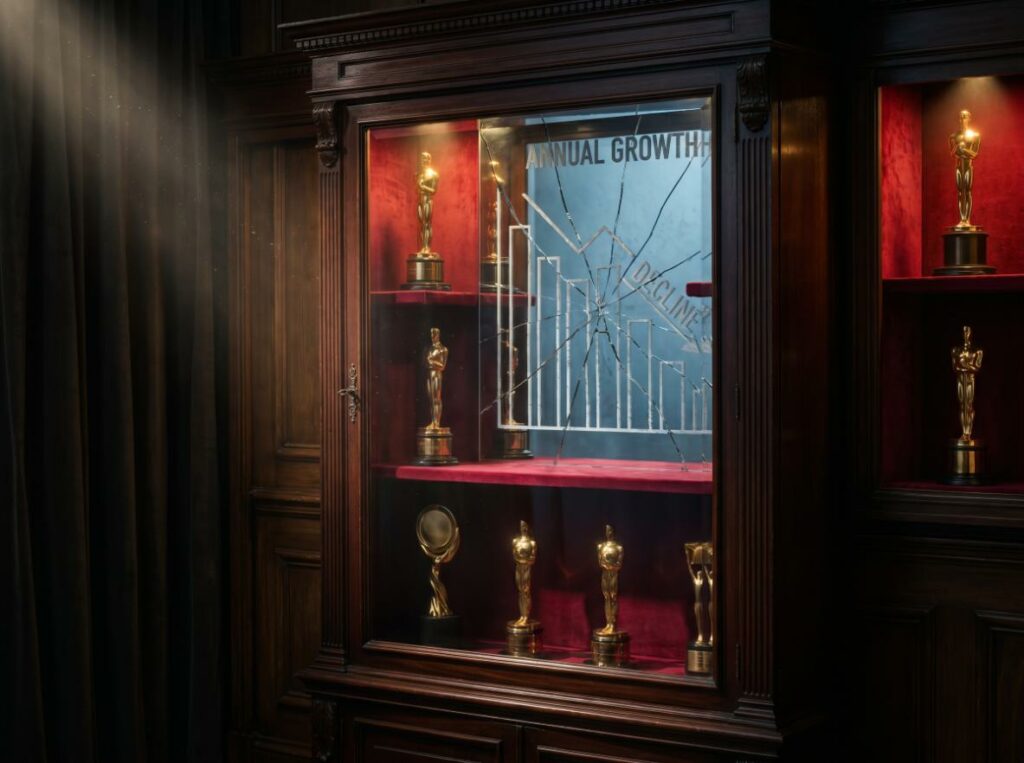
WPP wasn’t the only winner whose laurels wilted under scrutiny. Omnicom’s DDB network claimed Network of the Year at the same festival, a win that coexisted with the inconvenient fact that the agency had to withdraw three entries for cheating. DDB has since been folded into TBWA — effectively retired as a standalone brand — which, as the same report dryly observed, suggests “the connection between supposed creative excellence and commercial performance isn’t as direct as many (including the Cannes organisers) suggest.”
To their credit, the Cannes Lions organizers appear to recognize the problem. The Creative Company of the Year award has been retired entirely, and the Network of the Year category is being restructured with caps on shortlist contributions and adjusted weighting designed to prioritize quality over quantity. In their own words, the aim is to provide “a refreshed benchmark that reflects today’s creative landscape — grounded in credibility, integrity and excellence.” The implicit admission is damning: the previous benchmark lacked all three.
This self-correction is happening against a broader backdrop of institutional drift. As AdExchanger reported, the Cannes ecosystem has been progressively co-opted by forces far removed from creative craft — first by Madison Avenue agencies focused on TV, then by Big Tech platforms like Google, Amazon, and Meta, and most recently by retail media businesses from Uber to Walmart. The festival that once celebrated the art of cinema advertising now serves as a floating trade show for programmatic pipes and sponsored yacht parties. Even the neighboring Cannes Film Festival is struggling with relevance, its red carpets increasingly populated by social influencers in evening wear rather than studio talent.
None of this means that creative quality is irrelevant to advertising performance — it emphatically is. What it means is that the institution the industry has long relied upon to certify creative excellence has become an unreliable signal. When the top prize rewards entry volume rather than business outcomes, when the winning network is simultaneously withdrawing fraudulent submissions, and when the organizers themselves are dismantling and rebuilding their own categories to restore credibility, the prestige signal is broken.
For performance marketers whose livelihoods depend on return on ad spend, this should be liberating. It means the answer to “what creative will actually work?” won’t be found by studying last year’s Grand Prix reel. It will be found by studying what’s working right now — in your category, for your competitors, at the unit-economics level where trophies don’t pay the bills.
The Attribution Illusion — Why “Great Creative” Gets Credit It Didn’t Earn
Every attribution model tells a story. The problem is that most of them are fiction.
Consider the mechanics of how conversions get counted in a typical multi-channel campaign. A consumer sees a billboard on their morning commute. That afternoon, they scroll past a brand video on Instagram — one with the kind of cinematic production value that might catch a juror’s eye at an awards show. Two days later, they Google the brand name, click a paid search ad with a straightforward offer, and convert. Last-touch attribution hands the entire credit to that search ad. The brand team, meanwhile, points to the Instagram video’s view count and claims the “halo effect” drove awareness. Neither narrative survives contact with actual cross-media data.
The clearest evidence comes from the Kochava cross-media study, which analyzed QSR campaigns and found that out-of-home advertising drove 96% of the demand that search later converted — yet the search budget received the attribution credit. As AdQuick’s analysis of the data put it, performance marketing as the industry currently defines it “describes the channel that closes a conversion, not the channel that causes it.” The search ad converted existing intent. It almost never created it. Somebody had to want the brand first, and something had to put the brand in their head. That something was overwhelmingly the unglamorous upstream channel — but the dashboard told a completely different story.
Now extend that same logic from channels to creative.
When a brand simultaneously runs an award-caliber brand film and a library of workhorse performance ads — the ugly-but-effective static images, the user-generated-content-style testimonials, the direct-response carousels — last-touch attribution credits the performance creative with the conversion. The performance team celebrates their ROAS. Meanwhile, the brand team credits the cinematic spot with generating the awareness that made the conversion possible. Both teams are operating in the same fog of misattribution that gave search credit for what OOH actually did. The award-winning creative gets submitted to Cannes. The performance creative gets scaled. And nobody actually knows which piece of creative caused the customer to act.
This isn’t just a measurement problem. It’s a strategic one. If the industry is, as the Kochava data demonstrates, fundamentally bad at knowing what actually caused the sale, then working backward from award-winning campaigns to inform your own creative strategy is building on a foundation of guesswork. You’re copying work that may have won a Lion for emotional resonance while contributing nothing measurable to the business outcome it’s credited with.
The fog thickens further when you consider that AI is restructuring the entire discovery layer of the internet. As Neil Patel observed in his analysis of Google’s 2026 announcements, AI-assisted answers and recommendations are reworking how consumers find brands, which means the already-leaky attribution pipeline is about to spring new holes that most measurement frameworks aren’t equipped to patch.
So what do you do when you can’t trust the scoreboard? You stop trying to reverse-engineer the play from the highlight reel and start studying the game film instead. Reverse-engineering competitors’ proven converting creative — the ads that are actually running, actually spending, actually scaling — gives you signal that no attribution model and no awards jury can provide. You’re not guessing which campaign generated demand and which campaign harvested it. You’re observing what the market is actually paying to distribute. That’s not a creative philosophy. It’s an epistemological advantage.
The Spy’s Advantage — Why Competitive Intelligence Beats Creative Inspiration
The most successful performance marketers don’t spend their mornings watching Cannes Lions sizzle reels. They spend them inside competitors’ ad libraries, tracking which creatives have been running for six weeks straight and which disappeared after three days. The difference between these two habits isn’t just aesthetic preference — it’s the difference between guessing what might work and studying what already does.
Competitive intelligence, when practiced as a systematic discipline rather than a casual glance, transforms creative development from an act of intuition into an empirical process. The logic is straightforward: if a competitor’s ad has been running continuously for two months across multiple placements, that ad is almost certainly generating positive returns. No performance team keeps spending behind a losing creative for eight weeks. By cataloging these durable runners — their hooks, their visual formats, their landing page structures, their calls to action — you’re effectively reverse-engineering what the market rewards with conversions, not applause.
This approach treats creative as a hypothesis to be tested, not a masterpiece to be unveiled. You observe that three competitors in your category have independently converged on short-form testimonial ads with bold text overlays. That convergence isn’t coincidence; it’s signal. You build your own variation, test it against your existing control, and let the data decide. If it wins, you scale it. If it doesn’t, you’ve lost a few hundred dollars in test spend rather than a six-figure production budget chasing an idea that felt brilliant in a conference room.
The framework extends well beyond individual ad creatives. As Brax has outlined, benchmarking your performance against industry-wide standards — examining average click-through rates, conversion rates, and cost-per-click across your category — is essential for understanding whether your campaigns are genuinely competitive or merely functional. When you combine this macro-level benchmarking with granular competitor monitoring, you create a feedback loop that traditional creative processes simply cannot match. You know not only what’s working for your brand but how that performance stacks up against the broader landscape.
The creative evaluation problem becomes even more acute at scale. When brands like Unilever are deploying networks of hundreds of thousands of creators producing AI-assisted content simultaneously, the old methods of assessing creative quality — human panels, quarterly brand-tracking surveys — collapse under their own weight. As Search Engine Journal reported, companies are now building infrastructure that can score creative effectiveness and link those scores to media performance in real time, surfacing signal from noise before budgets get allocated to the wrong places. This is the direction creative evaluation is heading: continuous, data-linked, and ruthlessly tied to outcomes.
None of this means creative instinct is worthless. It means that instinct should be informed by evidence rather than substituted for it. The spy’s advantage isn’t that they lack imagination — it’s that they refuse to let imagination operate in a vacuum. They watch what competitors launch, track what survives, note what gets abandoned, and use that intelligence to generate sharper hypotheses. By the time they sit down to brief a designer or write ad copy, they’ve already narrowed the field of possibilities to concepts with demonstrated market viability.
The trophy-chaser starts with “What would be remarkable?” The spy starts with “What’s already converting?” One of those questions has a verifiable answer.
What Performance-First Creative Actually Looks Like (And Why It’ll Never Win a Lion)
Pull up the Grand Prix winners from any recent Cannes Lions cycle and study the work. You’ll notice a pattern: sweeping cinematography, orchestral scores or conspicuous silence, a narrative arc that builds to an emotional crescendo, and a logo reveal timed like the final note of a symphony. Now pull up the top-performing direct-response ads in any Meta or TikTok ad library — the ones that have been running for weeks, burning budget because they keep converting. You’ll see shaky phone footage, a founder talking into the camera in their kitchen, text overlays that look like they were made in five minutes, and a benefit statement in the first 1.5 seconds. These two categories of creative are not just aesthetically different. They are structurally incompatible.
Award-show judging criteria reward originality, craft, and emotional storytelling. Performance-first creative rewards speed to value proposition, friction reduction, and iterative testing of hooks. A high-performing UGC-style native placement doesn’t open with a mood-setting drone shot; it opens with “I was skeptical too, but here’s what happened.” A benefit-led landing page doesn’t bury the call to action beneath a brand manifesto; it puts the offer above the fold with a button that says exactly what clicking it will do. These formats are designed to survive the scroll, not command a screening room.
The formats driving the most measurable returns right now are the ones built around user choice rather than forced attention. Consider rewarded ads in mobile gaming: in a 2025 survey of mobile game developers, 68% of those who ran rewarded user-acquisition campaigns reported improved ROAS, and 95% said they gained a competitive advantage. The mechanic is simple — users opt in, complete an engagement milestone, and earn something tangible in return. No cinematic thirty-second pre-roll. No skip button to wrestle with. Just a fair exchange where you’re paying for behavior, not clicks, and where economics align directly with lifetime value models. No Cannes jury has ever given a Grand Prix to an offerwall placement. They never will. That’s fine. The offerwall doesn’t need a trophy. It needs a positive marginal return.
There’s another dimension here that makes the incompatibility even sharper. As the Kochava cross-media study detailed on AdQuick’s blog found, passive advertising formats like out-of-home drive demand without triggering the “active refusal” friction that makes consumers resent high-frequency digital campaigns. Digital advertising is active advertising — it requires the consumer to either consume it or refuse it, and after enough refusals, that effort calcifies into resentment. OOH sidesteps this entirely. Yet passive formats are virtually invisible at creative award shows, which overwhelmingly celebrate the very active digital formats most likely to generate consumer fatigue at scale. The formats that build demand quietly get ignored. The formats that interrupt loudly get gilded.
Performance-first creative is ugly by design. It’s built to be iterated on weekly, not preserved in a case study. A performance team might test forty hook variations in a single sprint, kill thirty-seven of them, and scale the three survivors until fatigue sets in — then start again. The creative that wins isn’t the one the team is proudest of. It’s the one the data chose. This process produces work that looks cheap, feels disposable, and converts relentlessly.
The marketers chasing Lions are optimizing for the wrong audience. Judges evaluate craft, narrative, and cultural relevance. Buyers evaluate whether the thing being sold solves their problem, and whether the ad made that clear fast enough. These are different optimization functions with different objective metrics, and pretending otherwise is how brands end up with a shelf full of awards and a dashboard full of questions about where the revenue went.
The Real Cannes Effect — How Trophy-Chasing Distorts Budget Allocation
Every June, the Côte d’Azur becomes the advertising industry’s most expensive mirror — a place where holding companies, agencies, and increasingly anyone with a media budget gathers to celebrate work that may or may not have moved a single unit off a shelf. But the real cost of Cannes isn’t the rosé or the yacht rentals. It’s the way the festival warps organizational priorities, redirecting money, talent, and creative energy away from the campaigns that actually drive revenue.
Consider the math that Publicis quietly demonstrated. The holding company ditched Cannes entries entirely one year to save a reported €50 million, a staggering figure that encompasses entry fees, production costs for “awards versions” of campaigns, travel, hospitality, and the countless billable hours spent packaging work for jury consumption rather than consumer consumption. The sky didn’t fall. Publicis continued to win business, retain clients, and outperform several of its more trophy-obsessed rivals on the metrics that shareholders actually care about. Meanwhile, last year’s Creative Company of the Year award went to WPP — a recognition that looked conspicuously hollow given that, as the celebration unfolded on stage, the holding company’s commercial trajectory was visibly deteriorating. The disconnect between award-shelf prestige and business performance couldn’t have been more stark.
This isn’t an isolated irony. The same More About Advertising report noted that Omnicom’s DDB won Network of the Year despite having to withdraw three ads for cheating, a detail that should make any performance marketer question what signal, if any, a Lion actually transmits about creative quality. DDB has since been folded into TBWA, reinforcing the uncomfortable truth that supposed creative excellence and commercial performance aren’t nearly as correlated as the awards-industrial complex implies.
But the distortion runs deeper than wasted entry fees. When a creative team knows its work will be judged by a Cannes jury, the brief subtly shifts. Instead of optimizing for thumb-stopping hooks, rapid value propositions, and iterative variant testing — the unglamorous machinery of performance marketing — teams gravitate toward untested “big swing” campaigns designed for emotional impact on a single viewing. These campaigns get the internal greenlight not because the data supports them, but because they feel like contenders. The result is a systematic bias toward unproven spectacle at the expense of the iterative, data-proven creative that compounds returns over time.
And even if you still believed Cannes offered a meaningful creative signal, that signal has been diluted almost beyond recognition. As AdExchanger reported, the festival that once celebrated cinematic craft has been progressively steamrolled by ad tech platforms like Google, Amazon, and Meta, by retail media businesses including Uber, Walmart, and Albertsons, and most recently by social influencers in evening wear filling the celebrity vacuum left by retreating Hollywood studios. The creative festival has become a business development event dressed in black tie. When the sidewalks are clogged with influencers and the port is lined with ad tech yachts, you’re no longer attending a celebration of craft — you’re attending a trade show with better catering.
For performance marketers operating on fixed budgets, this matters enormously. Every dollar routed toward award-show packaging is a dollar not spent on creative testing, audience segmentation, or the kind of rapid iteration that actually moves ROAS. The opportunity cost isn’t theoretical — it’s the twenty variants you didn’t test, the winning hook you didn’t discover, and the scaling window you missed while your team was polishing a sizzle reel for the jury.