


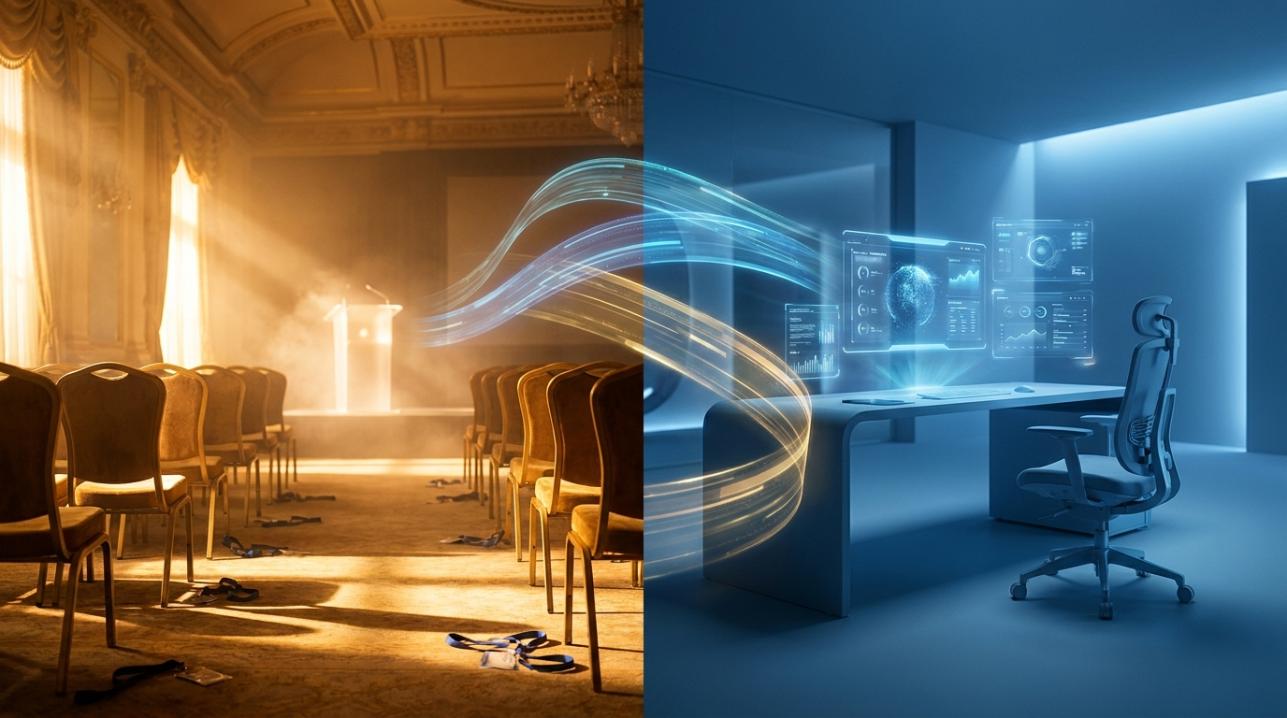
The Conference Promise — And What It Actually Delivers
Every June, the marketing world treats Cannes Lions like a pilgrimage. The industry press frames it as the event where competitive intelligence is exchanged over rosé on the Croisette — where you’ll overhear the strategy shift before it hits the trades, catch a platform announcement before it reaches your inbox, and absorb the trend that will define the next fiscal year. Conference organizers, sponsors, and the cottage industry of “Cannes wrap-up” content all reinforce the same message: if you weren’t in the room, you missed something essential.
But did you? When you strip away the French Riviera backdrop and the branded yacht parties, what most attendees actually carry home is a specific and surprisingly narrow category of information: high-level trend narratives packaged for a general audience, brand-safe case studies that have been scrubbed of any real performance data, and platform announcements that are simultaneously published online for anyone with a Wi-Fi connection. The information asymmetry between the person who spent $4,000 on a festival pass and the person who followed the hashtag from their desk is, in practical terms, approaching zero. Clix Marketing’s roundup of Cannes Lions confirmed the pattern — every major announcement from the festival was available online within the same week, often within hours, meaning the “exclusive” intelligence evaporated the moment a keynote ended.
This isn’t a knock on conferences as experiences. They are optimized — brilliantly, in fact — for inspiration and networking. A well-timed hallway conversation can unlock a partnership or a hire that changes a business. But inspiration and competitive intelligence are fundamentally different deliverables, and conflating the two leads marketers to overinvest in the wrong channel for the wrong outcome.

Consider what actual competitive intelligence requires. As TopRank Blog outlines in its breakdown of in-demand B2B content marketing services, a rigorous competitive content analysis involves competitor identification, content inventory, content performance evaluation, SEO assessment, and content gap analysis — the kind of disciplined, data-intensive work that identifies what your rivals are publishing, how it performs, and where they’ve left openings you can exploit. No keynote provides that. No fireside chat delivers a competitor’s SERP rankings or a map of the topics they haven’t covered. The gap between what a conference stage offers and what a Monday-morning media plan demands is vast.
The same principle applies to performance advertising. As Brax has noted, meaningful competitor benchmarking requires comparing your own click-through rates, conversion rates, and cost-per-click against industry-level data drawn from platform reports and research firms — not anecdotes shared over canapés. That kind of granular, quantitative context is what empowers marketers to identify gaps and design better strategies, and it lives in dashboards and benchmark reports, not in conference swag bags.
None of this means you should cancel your next registration. It means you should stop categorizing it as a competitive intelligence expense. Conferences sell access to a mood, a narrative, a sense of direction. What they don’t sell — and structurally cannot sell — is the tactical, number-rich, competitor-specific data that performance marketers need to make decisions that move revenue. Recognizing that distinction is the first step toward allocating your intelligence budget where it actually returns insight.
What a Competitive Analysis Actually Requires in 2026
Before measuring what conferences or spy tools actually teach you, it’s worth establishing what a serious competitive analysis demands in 2026 — because the scope has expanded far beyond what most teams realize.
The foundational shift is that competition no longer plays out on a single surface. As Semrush outlines in its updated competitive analysis framework, a complete audit now covers three distinct surfaces: what the brand says about itself through its own marketing and sales content, what third parties say through reviews, press coverage, and community discussions, and what AI search platforms say — including how often a competitor is mentioned, the sentiment of those mentions, and which prompts trigger their appearance. The first two surfaces are familiar territory for any marketing team that’s been doing this work for a decade. The third is the one that’s rewriting the rules. Prospects are forming opinions about brands inside AI platforms before they ever visit a website, and any competitive analysis that stops short of tracking AI visibility is operating with a blind spot that grows wider every quarter.
But understanding the framework is only the beginning. The actual deliverables a rigorous competitor audit demands are data-intensive, specific, and ongoing. They include building a comprehensive content inventory of each competitor’s assets — blog posts, whitepapers, video libraries, webinar archives, and gated resources. They require performance benchmarking that goes beyond surface-level metrics to assess engagement rates, conversion pathways, and distribution strategies. A thorough SEO and SERP assessment maps keyword overlap, backlink profiles, and ranking trajectories across every competitor in the set. And share-of-voice measurement, which once meant tracking media mentions and social buzz, now extends into an entirely new category: as HubSpot’s analysis of AI search analytics tools details, the percentage of AI-generated responses that include a brand versus its competitors has become a key performance indicator, requiring teams to monitor specific conversational prompts across ChatGPT, Gemini, Perplexity, and other platforms where buyers increasingly begin their research.
Each of these deliverables requires structured data collection, consistent methodology, and the kind of longitudinal tracking that reveals trends rather than snapshots. Content gap analysis, for instance, isn’t a one-afternoon exercise — it demands cataloging what competitors publish, mapping those assets against buyer journey stages, evaluating performance signals, and identifying the white space where your brand can credibly win. AI visibility tracking demands even more rigor, since model updates and shifts in training data can change a brand’s presence overnight, making historical trending essential to distinguish genuine competitive movement from algorithmic noise.
Now hold this framework up against what a conference session delivers. A keynote speaker sharing a case study about their brand’s repositioning addresses none of these requirements with actionable specificity. A panel on “the future of content” doesn’t hand you a competitor’s content inventory or reveal which AI prompts surface their brand instead of yours. The mismatch isn’t subtle — it’s structural. Conferences trade in narrative and inspiration; competitive analysis trades in evidence and measurement. One gives you a story to repeat at your next team meeting. The other gives you a decision matrix that changes where you allocate budget. Confusing the two isn’t just an efficiency problem — it’s a strategic one that compounds every month the real work goes undone.
What Always-On Intelligence Tools Actually Show You (That a Keynote Never Will)
While a conference keynote delivers a single speaker’s curated narrative about “what’s working,” always-on intelligence tools operate on an entirely different plane — one where the data is granular, continuous, and impossible to spin. The gap between these two information streams isn’t a matter of degree; it’s a difference in kind. Understanding exactly what these platforms surface makes the contrast inescapable.
Start with live creative variations. Ad intelligence platforms let you pull up a competitor’s active campaigns across native, push, TikTok, and display — not a sanitized case study from six months ago, but the actual headlines, thumbnails, and body copy running right now. You can see which creative variants a rival is testing this week, how long each variation has been live, and which placements are receiving the heaviest rotation. That rotation frequency is itself a signal: a creative that keeps running is a creative that’s converting. No conference speaker will ever project their losing ad variants on screen and walk you through why they killed them — but a spy tool shows you the graveyard alongside the survivors.
Next, consider landing page structure. Intelligence platforms archive competitor landing pages over time, letting you track changes in layout, offer framing, CTA placement, and even pricing strategy. When a competitor swaps a long-form advertorial for a short quiz funnel, you see it the day it happens — not three quarters later when someone mentions it anecdotally during a fireside chat designed, as Content Marketing Institute explains, not to sell but to “condition the market” with thought leadership.
Then there’s the benchmarking layer. For direct-response advertisers, knowing your own CTR or CPC is only half the picture; you need to know where those numbers sit relative to the category. As the Brax Blog details in its guide to native advertising performance, platforms like Taboola publish benchmark reports across verticals that let you compare campaign metrics against industry-wide averages — turning what would otherwise be isolated data points into genuine competitive positioning. This kind of comparison is, in their words, “essentially competitor analysis, except you are comparing yourself with the industry as a whole.” A conference panel might reference “strong performance” or “above-average engagement,” but those phrases are deliberately vague. Benchmark data is not.
Spend estimates add another dimension entirely. Intelligence tools approximate how much a competitor is investing in specific channels, geos, and time windows. When a rival suddenly doubles spend on a particular traffic source, you learn about it in near real time — not during a Q&A session where the CMO deflects the budget question with a joke about “investing where it makes sense.”
Finally, the newest category of always-on intelligence — AI search citation tracking — addresses the third surface of competition outlined in the previous section. These tools monitor how often competitors are cited by AI platforms, track sentiment shifts over time, and alert you when a rival’s share of voice changes. This layer of visibility is entirely absent from the conference circuit, where speakers are still catching up to the concept itself.
The cumulative picture is unmistakable. For media buyers running performance campaigns, the intelligence that moves the needle is operational and creative: what copy is a competitor testing, what page structure is converting, how does your cost per click stack up against the vertical average. Intelligence tools deliver this continuously, in structured formats that feed directly into optimization workflows. Conference stages deliver polished narratives that have been scrubbed of every detail that would make them operationally useful. The question isn’t whether conferences have value — it’s whether that value has anything to do with competitive intelligence at all.
The “Hallway Track” Defense — And Why It’s Weaker Than You Think
Let’s give the hallway track its due, because it has earned some. The unplanned conversation at a conference — the one where a competitor’s former VP lets slip their real churn numbers over a second bourbon, or where a casual lunch leads to a co-marketing deal neither party planned — is a genuinely irreplaceable human experience. No dashboard replicates the trust built by breaking bread with someone. No tool surfaces the emotional subtext of a product leader confessing, off the record, that their roadmap pivot was born from desperation, not vision. If you’ve had one of those conversations, you remember it vividly, and you probably made a meaningful decision because of it.
Now let’s pressure-test whether that memory justifies the budget line.
The strongest version of the hallway-track argument rests on serendipity: you can’t engineer the conversation you didn’t know you needed. Fair enough. But serendipity is, by definition, unreliable. You can attend three conferences in a quarter and come home with nothing more actionable than a stack of branded socks. The insight economy of conferences is high variance and low frequency, which is exactly the wrong profile for an intelligence function that needs to inform weekly content decisions, quarterly positioning shifts, and real-time campaign adjustments.
Compare that variance against what’s now systematically accessible. The most consequential competitive surface in 2026 — how AI search platforms represent your brand versus your rivals — is, as Semrush’s competitive analysis framework makes explicit, completely invisible in any hallway conversation. No one at a cocktail reception is going to tell you which prompts trigger mentions of your competitor’s product in ChatGPT or Gemini, what sentiment those mentions carry, or how often your brand is absent from AI-generated recommendations entirely. That intelligence exists only in structured data, gathered continuously, analyzed programmatically. It compounds every week you collect it, and it atrophies every week you don’t.
Then there’s the argument that real competitive understanding requires “listening to real people” — a point TopRank Blog makes in the context of concept development, noting that generative AI can remix existing ideas but can’t surface what’s actually frustrating your buyers. That’s a valid claim, and conference proponents love to cite it as proof that face-to-face interaction is the ultimate listening channel. But the same article reveals the scale of the underlying problem: 57% of B2B marketers struggle to create the right content for their audience. A problem that widespread isn’t caused by a shortage of cocktail-hour anecdotes. It’s caused by the absence of systematic, structured listening — content gap analyses, competitor performance evaluations, SEO assessments — performed at a cadence that actually keeps pace with how fast buyer needs shift.
And here’s the part the hallway-track defense rarely acknowledges: the practitioners who once traded their best insights at conference after-parties have largely migrated to private Slack communities, invite-only Discord servers, and async forums where the conversation is continuous, searchable, and free. The serendipity hasn’t disappeared; it’s been redistributed to channels that don’t require a $2,500 registration fee and two days of travel.
None of this means networking is worthless. It means networking is networking — relationship-building, career development, cultural immersion. Those are real and legitimate returns. But they are not competitive intelligence, and conflating the two lets marketing teams justify conference budgets with ROI they can never actually measure while neglecting intelligence infrastructure that produces compounding, measurable returns from the first week it’s operational. The hallway track is a nice bonus. It is a terrible strategy.
The Real Cost Comparison — Conference Budget vs. Intelligence Stack
Let’s stop talking philosophy and start talking spreadsheets, because the math here is brutal for the conference circuit.
Take a single marquee marketing conference. The badge alone runs $1,500 to $3,000 or more for premium access. Layer on airfare ($400–$800 domestic, double that for international), four nights of hotel in a conference city ($250–$400 per night), meals, ground transport, and the incidental client dinners that somehow always end up at the steakhouse — and you’re looking at $4,000 to $7,000 per attendee, conservatively. Now multiply that across three team members, which is the minimum most performance marketing teams send if they want to cover parallel tracks. That’s $12,000 to $21,000 for a single event. Repeat two to four times per year, and the annual conference line item lands somewhere between $24,000 and $84,000 — before you even account for the hardest cost to quantify: three to five days of lost productivity per person, per event, in a function where every day a campaign runs unoptimized is money left on the table.
Now build the alternative stack. A competitive ad intelligence tool — the kind that lets you monitor creative rotations, landing page tests, and spend estimates across paid channels — runs $5,000 to $15,000 annually depending on the platform and seat count. An SEO and competitive benchmarking suite like the ones that power a complete competitive analysis across all three surfaces of a competitor’s brand costs roughly $3,000 to $12,000 per year. Add an AI visibility tracker — the emerging category HubSpot describes as essential for monitoring how and in what context AI systems mention your brand alongside competitors — at $5,000 to $10,000 annually. Total tool spend: $13,000 to $37,000. Budget another $15,000 to $25,000 for dedicated analyst time (whether a fractional hire or carved from an existing role) to run monthly competitive reviews, synthesize findings, and push recommendations to campaign managers. All in, the intelligence stack costs $28,000 to $62,000 per year — comparable to or less than the conference circuit, even at the low end of conference attendance.
The output gap, however, isn’t comparable at all. A conference yields a handful of impressionistic takeaways that decay within weeks, filtered through the biases of whoever happened to attend which session. An intelligence stack produces continuous, timestamped, searchable insight. As HubSpot’s framework for evaluating these platforms makes clear, tools that offer historical trending, alerting, and integrations into existing workflows create intelligence that is cumulative and compounding — each month’s data makes last month’s more meaningful, and automated alerts ensure the team reacts to competitor moves in near real-time rather than waiting for the next quarterly offsite to compare notes. The shelf life of a conference insight is the flight home. The shelf life of a properly maintained competitive dashboard is the lifetime of the subscription.
Speed-to-insight tells a similar story. A competitor launches a new landing page variant on Tuesday; your ad spy tool flags it Wednesday morning. A rival’s share of voice in AI search jumps fifteen points after a major product launch; your tracker surfaces the shift within the week. At a conference, you might hear a rumor about that launch during a breakout session — two months after it happened — and still have no data to verify whether the strategy actually worked.
None of this means conferences deliver zero value. But when you model the math honestly, the conference circuit is one of the most expensive and least efficient competitive intelligence strategies available to a performance marketing team. Dollar for dollar, the same budget redirected into tools and the analyst discipline to use them produces not incrementally more insight, but orders of magnitude more — delivered continuously rather than episodically, and grounded in observed behavior rather than curated narrative.
A Hybrid Model for Marketers Who Won’t Give Up the Badge
So you’ve seen the math, and you’re still not ready to surrender your lanyard. Good — because the smartest approach isn’t an either-or decision. It’s a ratio. Call it the “1 conference, 12 months of tools” rule: attend one carefully chosen industry event per year for the things only a room full of humans can deliver, and fund a persistent intelligence stack that does the heavy lifting the other 364 days.
The key word is persistent. A competitive analysis isn’t a quarterly ritual or a pre-launch scramble. As Semrush emphasizes, a thorough competitive analysis now covers three distinct surfaces — what competitors say about themselves, what third parties say about them, and how they show up inside AI search platforms. That’s a living, breathing landscape that shifts weekly. No single conference snapshot, no matter how packed with keynotes, can track that kind of movement. Your always-on stack — SEO monitors, ad libraries, social listening tools, AI visibility trackers — becomes the primary system of record, updating while you sleep.
But here’s where the hybrid model earns its name: you use those tool insights to make your one conference wildly more productive. The workflow looks like this. In the months leading up to the event, your intelligence stack surfaces specific anomalies — a competitor’s sudden push into a new content category, unexplained spikes in paid spend, a gap in their coverage that no one in the category has addressed yet. You catalog those signals and translate them into precise, conversational questions. Not “So, what’s new at your company?” but “I noticed you pulled back from programmatic in Q2 — was that a channel decision or a budget reallocation?” That’s the kind of question that produces a real answer over a second bourbon, and it’s a question you would never know to ask without the data running in the background.
Before the conference, build a target list of no more than ten people you want face time with — former competitors, adjacent partners, analysts who cover your space. Reach out early, lock in coffee meetings or dinner seats, and arrive with an agenda invisible to everyone but you. Every hallway conversation becomes a guided interview shaped by months of signals.
After the event, the loop closes. Feed what you learned — the off-the-record context, the strategic hints, the relationship insights — back into your competitive files. Layer that qualitative color on top of the quantitative data your tools already hold. A dashboard can tell you a rival’s organic traffic dropped fifteen percent; a candid conference conversation can tell you their head of content just quit and they’re three months from a replatform. Together, those two data points become genuinely actionable intelligence.
The budget arithmetic reinforces the split. Take the cost of a second or third annual conference — easily $4,000 to $6,000 each — and redirect it into tooling. That reallocation funds a robust stack that, as industry benchmarking research suggests, lets you compare your performance not just against a handful of rivals you happened to meet at a booth, but against the industry as a whole, across every channel, all year long.
One badge. Twelve months of data. Every hallway question sharpened by the intelligence you carried in your pocket. That’s not a compromise — it’s a compounding advantage.